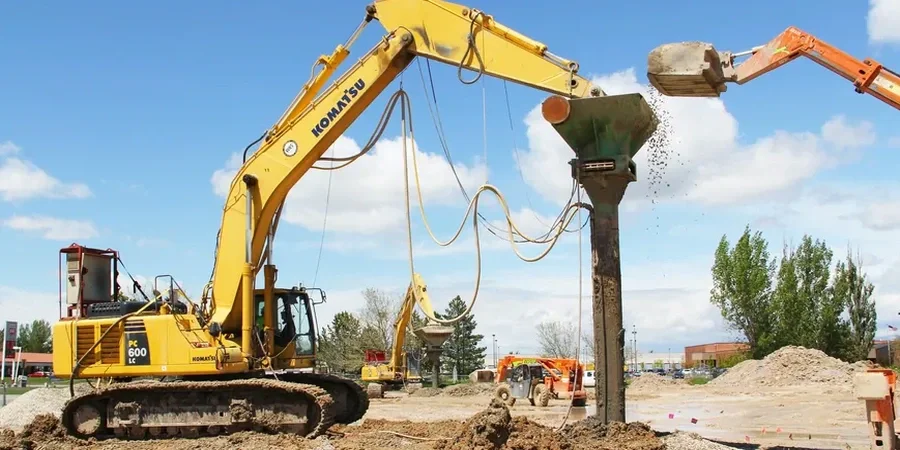
ASCE 7 and the IBC establish clear performance criteria for ground improvement, but applying them in a city like Rochester requires an intimate understanding of what lies beneath the pavement. Our team has spent years interpreting how the dense glacial till and the softer post-glacial silts—deposited by the Genesee River over millennia—respond to deep vibratory methods. The challenge here is rarely uniform soil; it is the erratic lenses of sand and silt that create differential settlement risk on a single site. A well-executed vibrocompaction design is not just about reaching a target relative density, it is about mapping these lenses accurately with in-situ CPT testing before the first vibroflot goes into the ground. When the design phase integrates high-resolution stratigraphy, the compaction grid can be tuned to the specific energy requirements of each zone, avoiding both over-treatment in the till and under-treatment in the compressible pockets.
In Rochester, the difference between a successful vibrocompaction job and a settlement problem is often the ability to adjust the grid in real time when the fill thickness changes abruptly.
Local ground factors
The contrast between a site near the University of Rochester and one out in Henrietta can be stark. Near the river, we see saturated silty sands that are prone to cyclic mobility; further south, the soil transitions to a stiffer, overconsolidated till. The biggest risk we see in the city is assuming that a single compaction energy will work across a site that straddles two distinct geologic units. If the design does not account for a sudden increase in fines content—common in the transitional zone between the lake plain and the drumlin field—the vibroflot can struggle to transmit energy effectively, leaving untreated pockets that later manifest as differential settlement beneath floor slabs. We mitigate this by staging a pre-production test panel: a small area where we test two energy levels and two spacings, then verify with a series of post-compaction CPT soundings. This test section, required by IBC for performance-based design, gives us the empirical data to fine-tune the production grid before we commit to the full site.
Questions and answers
What types of Rochester soils are suitable for vibrocompaction?
The method works best in granular soils with less than 15 percent passing the #200 sieve. In Rochester, this generally means the cleaner sands found in the glacial outwash deposits and some portions of the historic fill, provided the fill is not dominated by cohesive material or large debris. We always run a grain size analysis first to confirm suitability.
How long does a typical vibrocompaction project in Rochester take?
A standard residential or light commercial lot in the Rochester area, treating a depth of 25 to 30 feet, typically requires one to two days of vibroflot operation. Larger commercial sites can take a week or more. The schedule depends on the grid spacing and the number of passes needed to reach the target density.
What is the approximate cost range for vibrocompaction design and verification in Rochester?
For a typical project in the Rochester area, the combined design package and post-treatment verification testing generally falls between US$1,580 and US$5,700, depending on the site size, the number of verification soundings required, and whether a pre-production test panel is included in the scope.
How do you verify that the ground improvement actually worked?
We perform a series of CPT soundings at agreed-upon locations after the vibrocompaction is complete, and compare the tip resistance and sleeve friction to the pre-treatment baseline. We also run SPT tests in select locations. The acceptance criteria are defined in the design phase and tied directly to the settlement performance required by the structural engineer.
Can vibrocompaction replace deep foundations in Rochester?
In many cases, yes. If the treatment depth can reach a competent bearing stratum and the improved ground meets the settlement tolerance for the structure, a shallow footing system on treated ground can be a cost-effective alternative to driven piles or drilled shafts. We evaluate this on a site-by-site basis, considering the proximity to adjacent structures and the sensitivity of the proposed construction.