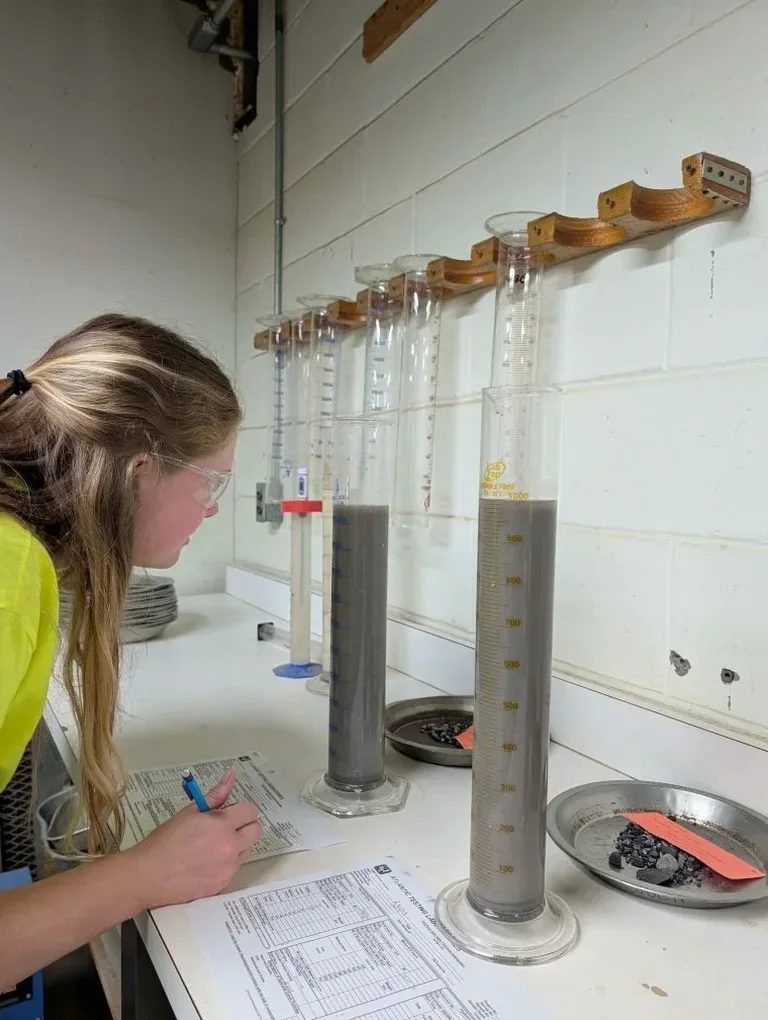
Glacial till and glaciolacustrine clay dominate the shallow geology across Rochester, with the Lake Ontario plain setting the water table just a few feet below grade. These fine-grained soils soften fast during the spring thaw, and a standard Proctor won't tell you what happens after saturation. That's where our laboratory CBR test comes in. We run AASHTO T 193 on remolded samples compacted at optimum moisture, then soak them for 96 hours before the piston penetration. The result is a soaked CBR value that Rochester pavement designers can plug straight into the 1993 AASHTO flexible pavement equation. No guesswork. Just a number backed by a controlled soak and a calibrated loading frame.
A 96-hour soak under a 10-pound surcharge tells you more about Rochester subgrade than any dry strength test ever will.
Our approach and scope
Rochester sits at roughly 505 feet above sea level with a frost depth of 48 inches per the IBC, and that freeze-thaw cycle is brutal on subgrade. A CBR of 3 or less—common in the silty clays along the Genesee River corridor—means you need a thicker stone base or stabilization. Our laboratory CBR test follows the three-point compaction method: we mold specimens at 10, 30, and 65 blows per lift with the 10-pound rammer, then soak them in a water bath that maintains 0.01 inch of free water above the specimen. Surcharge weights simulate the overlying pavement structure. We record the load-penetration curve at 0.025-inch intervals up to 0.500 inches, correct for concavity if needed, and report both the corrected CBR and the swell percentage. For projects where the subgrade varies sharply, we sometimes pair soaked CBR runs with Atterberg limits to flag high-plasticity pockets before they end up under the asphalt.
Questions and answers
What does a laboratory CBR test cost in Rochester?
A single-point soaked CBR with the companion Proctor typically runs between US$140 and US$240, depending on whether we're running one compaction point or the full three-point curve. The three-point method costs more up front but gives you a much better picture of how sensitive the soil is to compaction effort—worth it when the subgrade varies across the site.
How long does the CBR test take from sample drop-off to results?
Count on seven business days minimum. Soaking alone takes 96 hours per AASHTO T 193, and we can't shortcut that. Add time for sample prep, compaction, moisture content determination, and the penetration test itself. If you need rush results, call us before you drop off the sample—we can sometimes overlap steps on multiple molds.
Do you need undisturbed Shelby tubes or just bag samples?
Bag samples are fine. The laboratory CBR test uses remolded specimens compacted in a 6-inch mold, so we don't need undisturbed material. What we do need is enough soil to run the Proctor first—typically 50 to 60 pounds of representative material per soil type. If the subgrade changes across the site, send separate bags with clear station labels.