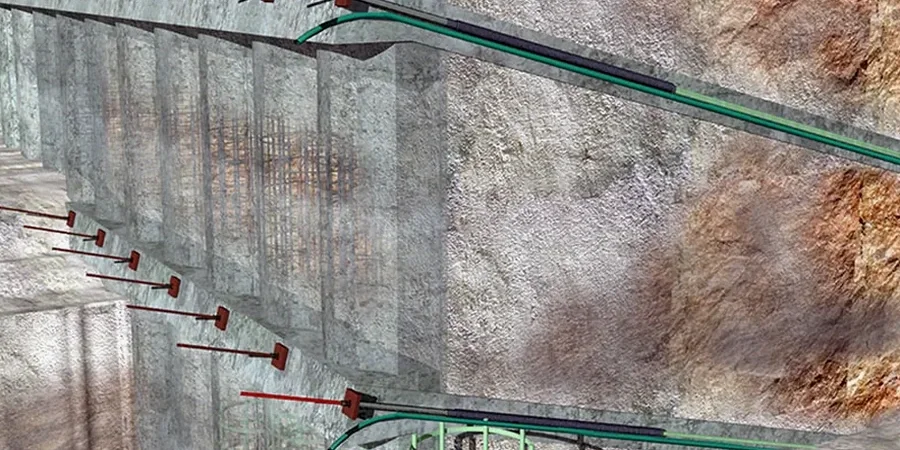
The soil profile under Rochester tells two different stories depending on which side of the Genesee River you are on. West of the river, near the old canal bed, the stratigraphy is dominated by glaciolacustrine silts and clays from the former Lake Iroquois shoreline. East into the Irondequoit area, dense glacial till with cobbles and boulders sits much closer to the surface. Neither ground condition forgives an anchor design that treats the city as a single geologic unit. A tieback anchor that holds 80 kips in the till east of Culver Road can creep and fail at half that load in the sensitive Champlain Sea deposits just a few miles away. Working across Monroe County since before the Inner Loop fill project, our team sizes active and passive anchor systems by mapping the actual stratigraphic boundaries that define Rochester’s subsurface, not by applying generic textbook assumptions.
Rochester’s glacial lake plain demands anchor bond zones start below the 42-inch frost line, not at the textbook 5-foot depth.
Our approach and scope
A 35-foot excavation on East Main Street last winter showed exactly why Rochester projects need anchor design calibrated to local freeze-thaw cycles. The general contractor had soldier piles driven into the stiff clay till, with a single row of active tiebacks specified at 22 feet on center. During a January cold snap, frost penetration reached 28 inches in the exposed face, and the bond zone in the upper weathered till lost nearly 30 percent of its capacity over a five-day period. We had to switch the load-transfer mechanism mid-project, converting two of the anchors to a passive system with a longer unbonded length and regrouting the bond zone under pressure. That kind of field adjustment is not unusual here. The IBC requires frost-depth consideration for shallow foundations, but the same thermal gradient affects anchor performance when the grout column sits within the active frost zone. Our anchor designs for Rochester always include a sacrificial bond length in the upper 4 feet, with the working bond zone starting below the historic frost line of 42 inches recorded by the Northeast Regional Climate Center. On sites where the groundwater table rises during spring melt, we also specify double corrosion protection per PTI DC-35, because the de-icing salts that wash into Rochester’s tight clay can accelerate strand corrosion faster than chloride levels alone would predict.
Local ground factors
The most expensive mistake we see in Rochester excavations is specifying active anchors with bond lengths that land inside the failure wedge of the cut. When the bonded portion of the tendon sits behind the theoretical sliding surface, the anchor does its job. When a contractor shortens the unbonded length to save on strand and places the bond zone partially inside the active wedge, the anchor can unload progressively as the soil mass moves. In the varved clays along the Genesee River corridor, that progressive unloading does not announce itself with a loud crack. The wall moves an inch, then another, and by the time the survey crew catches the deflection, three anchors have lost 40 percent of their lock-off load. Re-tensioning is not always possible if the wedge shear plane already cut through the grout column. We have had to design supplemental passive anchors installed through the wall face on two downtown projects where this exact scenario played out. A proper anchor design for Rochester’s soil stratigraphy defines the unbonded length by the Rankine or Coulomb wedge geometry plus a safety buffer of at least 5 feet into competent till, verified by the SPT refusal depths logged during the site investigation.
Questions and answers
What is the difference between active and passive anchors for a Rochester excavation?
Active anchors are prestressed after installation. We apply a hydraulic jack to tension the strand against the wall before locking off at a design load, typically 70 to 80 percent of the ultimate capacity. This actively restrains the soil mass and limits wall movement to less than half an inch in most Rochester till profiles. Passive anchors, also called reaction anchors, are not prestressed. They develop resistance only when the wall moves enough to engage the bond zone. In Rochester’s overconsolidated glacial till, passive systems work well for cuts under 20 feet where some movement is acceptable. For deeper excavations next to existing structures along East Avenue or near the Strong Museum, active tiebacks are almost always required to meet the 1:500 deflection criteria that protect adjacent foundations.
How much does active/passive anchor design cost for a project in Rochester?
Anchor design fees for a typical Rochester excavation project range from US$1,140 to US$3,690, depending on the number of anchor rows, the complexity of the soil profile, and whether the project requires corrosion protection for a permanent installation. A single-tier temporary tieback design for a 20-foot cut in uniform till falls at the lower end. A multi-row permanent anchored wall with double corrosion protection, performance testing specifications, and long-term monitoring plans moves toward the upper range. We deliver a fixed-fee proposal after reviewing the geotechnical baseline report and the structural wall layout.
Which ASTM standards apply to anchor testing in New York State?
Anchor testing follows ASTM D3689 for static axial tensile load capacity, with the loading schedule adapted per PTI DC-35 recommendations. Proof tests apply 133 percent of the design load held for 10 minutes, and we monitor creep movement during the hold period. Performance tests on sacrificial anchors use cyclic loading to verify that the bond zone behaves elastically within the working load range. In Rochester’s sensitive glaciolacustrine clays, we add an extended creep test of 60 minutes when the sustained load exceeds 60 percent of the estimated ultimate bond capacity, because the varved clay structure can exhibit time-dependent creep that a standard 10-minute test does not capture.
Why does frost depth matter for anchor design in Monroe County?
Rochester’s design frost depth is 42 inches, based on National Weather Service climate normals for the region. When an anchor bond zone starts within the frost-affected soil layer, freeze-thaw cycles can degrade the grout-to-soil bond through ice lens formation and volumetric expansion. We specify that the working bond zone begins at least 12 inches below the 42-inch frost line, meaning the top of the bond sits at 54 inches or deeper. The unbonded length passes through the frost zone with a smooth sheath to prevent load transfer in that zone. On projects where the anchor head itself is exposed to winter air, we also specify a thermal break detail at the bearing plate to prevent frost jacking of the wedge plate.