← Home · Seismic

Base Isolation Seismic Design in Rochester: Protecting Buildings from Seismic and Ground Motion Risks

Together, we solve the challenges of tomorrow.

LEARN MORE →

A common mistake in Rochester is assuming seismic design is only a West Coast problem. The reality is different. The city sits on deep glacial till and lacustrine clay deposits that amplify long-period ground motion, a risk often overlooked until the structural design phase. A conventional fixed-base building in the downtown area can experience unexpected drift if the soil-structure interaction isn't modeled correctly. We help project teams avoid this by integrating base isolation early in the design sequence. Our work aligns with ASCE 7-22 Chapter 17 and the IBC, ensuring the isolation system — whether elastomeric bearings or friction pendulum sliders — meets the performance objectives for the Design Basis Earthquake and Maximum Considered Earthquake. We also coordinate with liquefaction assessments when site-specific response spectra indicate deep soft layers prone to cyclic degradation, a condition present near the Genesee River corridor.

In Rochester's glacial lake plains, resonance between soft clay sites and mid-rise structures can double the seismic demand — base isolation breaks that dangerous dynamic coupling.

Our approach and scope

A mid-rise medical office building planned near the Strong Memorial Hospital campus faced a significant challenge: the site investigation revealed up to 45 feet of soft varved clay over bedrock, with a fundamental period that nearly matched the structure's fixed-base period. The structural engineer recognized the resonance risk immediately. Our team developed a site-specific isolation model using nonlinear time-history analysis, selecting lead-rubber bearings tuned to shift the effective period beyond 2.5 seconds. The design reduced the base shear by 60 percent compared to a fixed-base alternative. Beyond the dynamic analysis, we verified soil bearing capacity under the isolator pedestals with plate load test data and confirmed that the underlying clay would not undergo undrained creep under sustained eccentric loads. For projects on challenging Rochester profiles, combining isolation with stone columns under the foundation mat can address both seismic and settlement concerns in a single geotechnical package.
Base Isolation Seismic Design in Rochester: Protecting Buildings from Seismic and Ground Motion Risks
Technical reference image — Rochester

Local ground factors

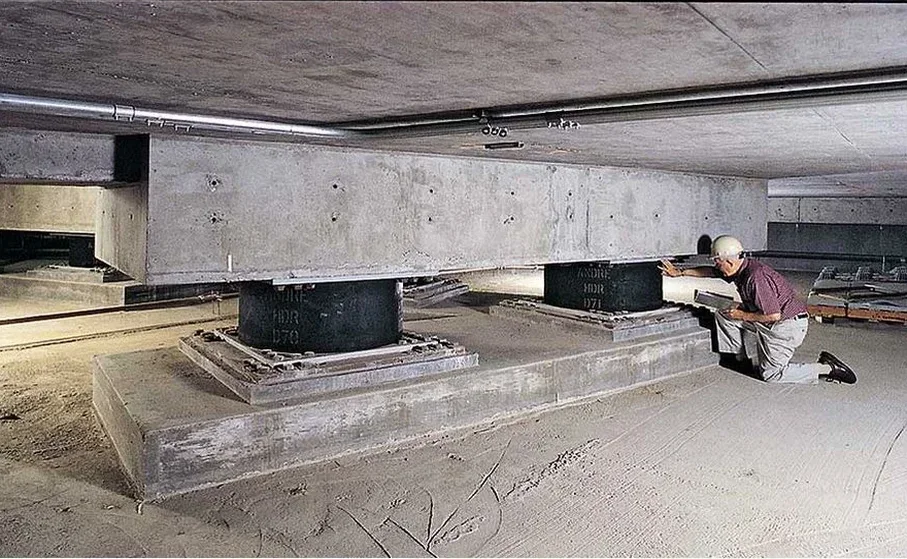
The lead-rubber bearings we specify for Rochester projects arrive from the manufacturer with full QA documentation — each unit tested to 150 percent of MCE displacement before shipping. On site, the critical moment is the installation sequence. If the isolator pedestals are even slightly out of level, the bearing capacity drops and the hysteretic loop degrades. We inspect every pedestal formwork pour and verify anchor bolt templates against the theoretical isolator center coordinates. After concrete reaches strength, we survey the top plate elevations to within 1/16-inch tolerance. The building superstructure then sits on a rigid diaphragm that must remain fully decoupled from surrounding grade beams and utilities. Rochester's freeze-thaw cycles add another layer of concern: any rigid connection to the perimeter — a misaligned stair tower or a utility sleeve cast into the isolation plane — creates a thermal short-circuit and a seismic load path bypass. Our field reviews catch these details before the concrete pour.

Need a geotechnical assessment?

Reply within 24h.

Email: info@geotechnicalengineering1.sbs

Technical data

ParameterTypical value
Design spectral acceleration (SDS)0.15g – 0.25g (per ASCE 7-22, Site Class E)
Target isolation period2.0 – 3.0 seconds (beyond site predominant period)
Isolator types evaluatedLead-rubber bearings (LRB), friction pendulum (FPS)
Analysis methodNonlinear time-history (NTH), 11 ground motion pairs
Maximum isolator displacement (MCE)14 – 22 inches (site-specific)
Bearing capacity under isolatorsVerified via ASTM D1194 plate load tests
Applicable standardASCE 7-22 Chapter 17, IBC 2021

Associated technical services

01

Nonlinear Seismic Isolation Design

We develop 3D isolation models with nonlinear link elements calibrated to prototype bearing test data. The analysis includes MCE-level displacement checks, stability under P-delta effects, and wind load lock-up verification per ASCE 7-22.

02

Geotechnical Coordination for Isolator Foundations

Isolation concentrates load under discrete pedestals. We design the foundation subgrade preparation, evaluate bearing capacity and settlement under cyclic demands, and specify quality control testing — plate load tests, SPT borings, and laboratory consolidation tests on undisturbed Shelby tube samples.

Reference standards

ASCE 7-22 Minimum Design Loads for Buildings and Other Structures, Chapter 17 (Seismic Isolation), IBC 2021 International Building Code, Chapter 18 (Soils and Foundations), ASTM D1586 Standard Test Method for Standard Penetration Test (SPT) and Split-Barrel Sampling of Soils, ASTM D2487 Standard Practice for Classification of Soils for Engineering Purposes (Unified Soil Classification System)

Questions and answers

How much does base isolation seismic design cost for a Rochester project?

For a typical mid-rise building in the Rochester area, the engineering design and analysis for a base isolation system falls in the range of US$3,830 to US$8,710 depending on the complexity of the nonlinear modeling, the number of ground motion pairs required, and the level of peer review coordination. The isolator hardware is a separate manufacturer cost.

Is base isolation really necessary in Rochester, NY?

Rochester is in a moderate seismic hazard region, but the local soil conditions — deep glacial lake deposits — can amplify long-period ground motion in ways that short-period hazard maps don't capture. For essential facilities, hospitals, and data centers, the IBC requires assessment of soil-structure interaction effects that often make isolation the most cost-effective compliance path.

What soil information do you need to start the isolation design?

We need a complete geotechnical investigation with deep borings to bedrock, shear wave velocity profiles (Vs30), undrained shear strength data for cohesive layers, standard penetration test (SPT) blow counts, and laboratory consolidation test results. Site class determination per ASCE 7 Chapter 20 is the starting point for establishing the design ground motion.

How does the isolation plane interact with Rochester frost depth requirements?

The isolation plane typically sits above the foundation mat and below the first structural slab. Frost depth in Monroe County is 48 inches, so the foundation mat and isolator pedestals extend below that elevation. The gap between the isolated superstructure and surrounding grade must be detailed to prevent soil intrusion while maintaining unrestricted movement during a seismic event.
Location and service area

We serve projects in Rochester and surrounding areas.

View larger map