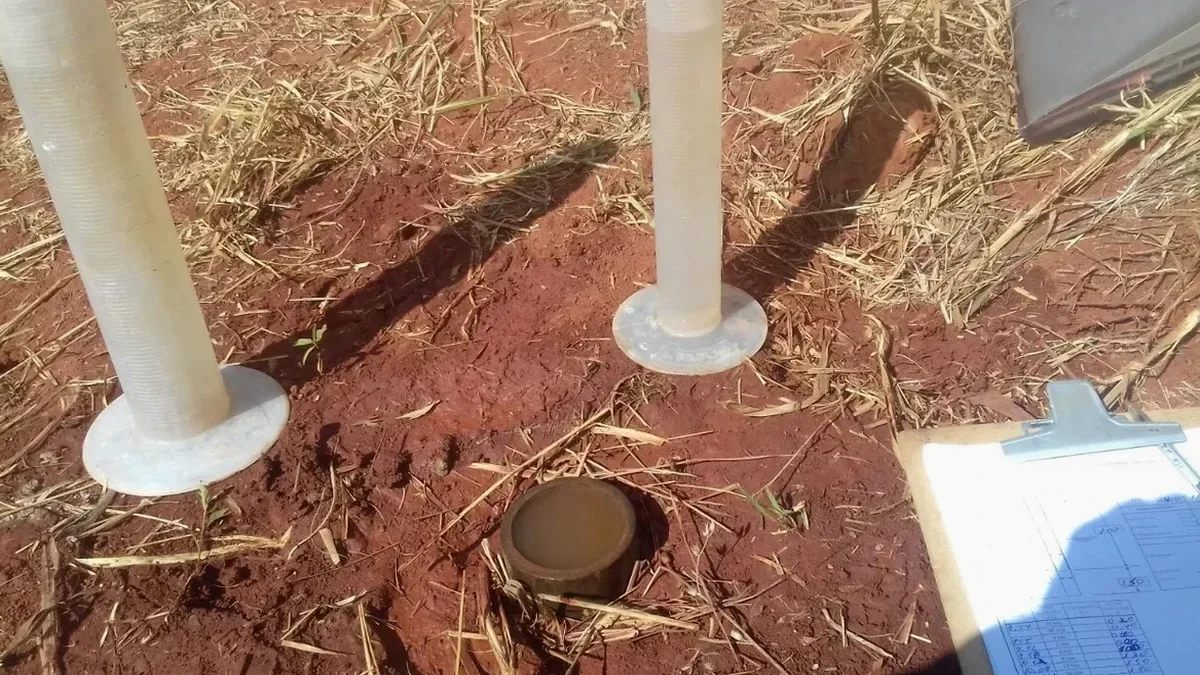
Running a field permeability test in Rochester starts with the rig setup—typically a truck-mounted rotary drill with a wireline system that can push through the dense glacial till blanketing much of Monroe County. For the Lefranc method, the crew lowers a slotted PVC screen into a borehole advanced below the water table, isolates the test zone with a bentonite seal, and uses a Mariotte bottle to maintain constant head while measuring the flow rate. When the job shifts to the Lockport dolomite or the shale bedrock that underlies the Genesee River Valley, the protocol changes entirely. A Lugeon test requires a double packer assembly inflated at precise depths to isolate discrete fracture zones, followed by a multistage pressure injection to quantify the rock mass permeability in Lugeon units. These tools travel with our team to sites from downtown high-rises near the High Falls District to suburban retention basins in Henrietta, where understanding the hydraulic conductivity of the native soil directly determines the feasibility of infiltration-based stormwater management under the updated NYSDEC stormwater design manual.
A single Lugeon test in the Lockport dolomite can reveal whether a deep excavation near the Inner Loop will stay dry or require a full grout curtain.
Local ground factors
The 2020 New York State Building Code, which adopts the IBC with local amendments enforced by the City of Rochester's Bureau of Buildings, requires that foundation designs account for hydrostatic pressure and groundwater flow—yet too many projects still rely on textbook values instead of site-specific field measurements. In Rochester, the risk of underestimating bedrock permeability is particularly acute along the Irondequoit Creek corridor and the former millrace alignments that crisscross the city, where historical industrial fill obscures natural drainage pathways. A Lefranc test that returns a permeability of 1x10⁻⁴ cm/s versus an assumed 1x10⁻⁶ cm/s changes the dewatering pump capacity from a modest 50 GPM to over 300 GPM, which impacts both cost and excavation safety. When the Lugeon test reveals fracture connectivity exceeding 20 Lugeon units, the engineering team must pivot from a conventional sump-pumping approach to a grouting program that treats the rock mass before excavation proceeds. Missing this step in Rochester's glacially overconsolidated soils, where hydraulic conductivity can jump two orders of magnitude across a single stratigraphic contact, has led to flooded excavations, delayed schedules, and costly change orders on projects near the University of Rochester Medical Center expansion zone.
Questions and answers
When does a Rochester project require a field permeability test instead of relying on lab permeameter results?
Lab permeameter tests on Shelby tube or split-spoon samples provide point measurements that rarely capture the influence of fractures, fissures, or sand lenses in Rochester's glacial stratigraphy. The NYSDEC stormwater design manual requires field testing for infiltration practices, and the IBC Section 1803 mandates site-specific groundwater evaluation when the water table is within the zone of influence. A field test integrates the permeability of a much larger soil or rock volume, revealing preferential flow paths that a 3-inch diameter lab specimen cannot represent.
What is the cost range for a Lefranc or Lugeon test in the Rochester area?
A single Lefranc test in a soil borehole typically falls between US$570 and US$950, depending on depth and whether constant-head or falling-head protocol is used. Lugeon packer testing in bedrock runs higher due to the packer assembly, pressure control system, and longer test duration—generally in the same range per test interval when it can be integrated into an existing drilling program. Mobilization, traffic control in busy Rochester corridors, and any test at depths beyond 80 feet will push costs toward the upper end.
How deep into the Lockport dolomite do you typically need to test for a building foundation in downtown Rochester?
For mid-rise and high-rise structures founded on caissons or drilled shafts bearing on competent rock, we typically test the upper 20 to 40 feet of the Lockport Formation, with test intervals spaced every 10 feet. The most critical zone is the weathered upper contact between the glacial till and the dolomite surface, where permeability values can spike to 30-50 Lugeon units due to solution-enlarged joints. A minimum of two Lugeon test intervals—one in the weathered zone and one in the competent rock below—provides the hydraulic profile needed for socket design.
Can a Lugeon test be combined with a standard geotechnical boring on the same day in Rochester?
Absolutely, and that is the standard approach for our Rochester projects. The same rotary drill that advances the geotechnical boring through the overburden and sets casing can be used to extend the hole into bedrock, and the Lugeon packer assembly is lowered on drill rods immediately after the rock core is retrieved. This eliminates a separate mobilization and allows the permeability data to be correlated directly with the recovered core's RQD and fracture logging. Coordination with the driller is essential to ensure the test zone is properly flushed and the packer seats in a competent portion of the borehole wall.