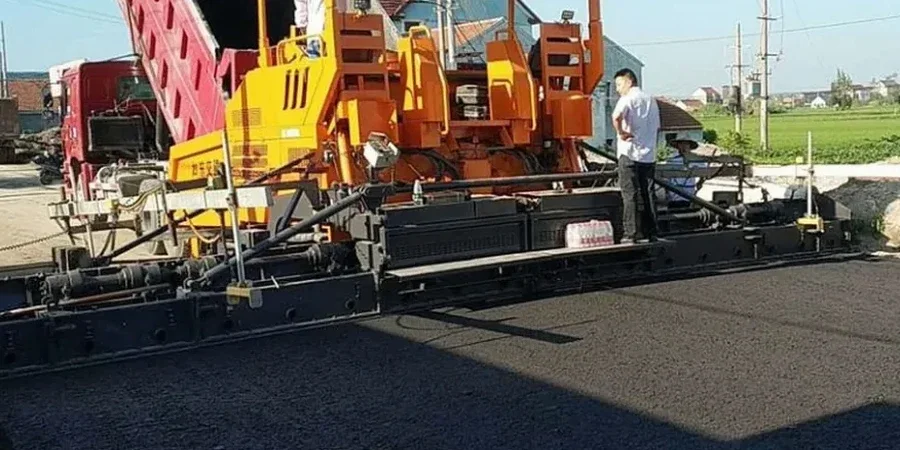
The plate compactor rumbles across the subgrade, its vibratory energy locking aggregate into a dense, load-bearing layer. In Rochester, where winter temperatures routinely dip below 20°F and spring brings saturated soils, flexible pavement design demands more than a standard catalog section. Our team looks at the full picture: the stiff, overconsolidated glacial till that dominates Monroe County, the drainage patterns off the Genesee River valley, and the traffic mix from passenger vehicles to heavy snowplows. We translate site-specific CBR testing into structural numbers, ensuring the asphalt thickness, base course, and subbase work as a unified system. This layered composite must withstand not only axle loads but also the relentless freeze-thaw cycles that can heave and crack an under-designed section.
In Rochester, a flexible pavement section lives or dies by its drainage design, not just its asphalt thickness.
Our approach and scope
ASCE 7 and the AASHTO 1993 Guide for Design of Pavement Structures set the baseline, but Rochester’s climate pushes us beyond default assumptions. The city averages over 95 inches of snow annually, and that meltwater is the enemy of untreated subgrade. We correlate laboratory resilient modulus with field deflection data, often finding that the native silty clay till needs stabilization with lime or cement to hit the required structural coefficient. Drainage details matter just as much as material specs. We specify open-graded base course layers and edge drains to intercept water before it saturates the subgrade, because a saturated base loses half its load-carrying capacity overnight. For sites near the canal or Irondequoit Bay, where groundwater is high, we design thicker granular layers and validate performance with deflection testing. Our lab runs ASTM D1883 CBR on remolded specimens at target moisture and density, and we back-check those numbers with field density via nuclear gauge testing before the first asphalt lift goes down.
Local ground factors
A commercial lot off West Ridge Road began showing alligator cracking within three years of placement. The original design assumed a CBR of 10 on the silty clay subgrade, but our forensic investigation found the actual soaked CBR was closer to 4. Freeze-thaw had pumped fines up into the base course, reducing its permeability to near zero. Water was trapped. The repair required full-depth reclamation, lime stabilization to a depth of 12 inches, and a redesigned cross-slope to move water off the pavement surface faster. The lesson is straightforward: Rochester's winter saturation is unforgiving. Skimping on subgrade preparation or assuming optimistic drainage coefficients leads to premature failure. We now require soaked CBR specimens cured through at least one freeze-thaw cycle when working with these glacial till soils, a protocol adapted from local NYSDOT research.
Questions and answers
What is the typical cost range for a flexible pavement design in Rochester?
For a standard commercial or light industrial project in the Rochester area, the pavement design package typically falls between US$1,840 and US$6,040, depending on the number of borings, traffic data complexity, and whether laboratory CBR or resilient modulus testing is required.
How does Rochester's freeze-thaw cycle affect flexible pavement performance?
Freeze-thaw cycles cause volumetric expansion and contraction in the subgrade, which can pump fine material into the base course and reduce its drainage capacity. We design for this by specifying non-frost-susceptible base materials, deeper granular layers, and positive drainage to keep water away from the frost zone.
Which AASHTO design method does your team use?
We follow the AASHTO 1993 Guide for Design of Pavement Structures, supplemented with NYSDOT regional calibration factors. For high-volume facilities, we may cross-check with AASHTOWare Pavement ME Design to validate performance predictions against local climate data.
What subgrade conditions are common in Rochester?
Most of Rochester sits on glacial till and glaciolacustrine deposits: stiff to hard silty clays with occasional sand lenses. CBR values typically range from 3 to 8 percent. Groundwater can be high near the Genesee River and Irondequoit Bay, requiring special drainage provisions in the pavement section.