← Home · Investigation

Standard Penetration Testing in Rochester NY: SPT Drilling & Soil Data

Together, we solve the challenges of tomorrow.

LEARN MORE →

Rochester's ground shifts with the seasons. The freeze-thaw cycles that chew up I-490 every March also alter near-surface soil structure in ways that a desk study simply won't catch. Glacial Lake Iroquois left behind a layered deposit of glaciolacustrine silts and clays punctuated by deltaic sands, and the contact between those units can vary by several feet across a single city lot. Running an SPT program here means penetrating those transitions with repeatable blow-count data. We mobilize a CME-75 rig with an automatic trip hammer calibrated to ASTM D1586, splitting spoon sampling at 5-foot intervals or at every stratum change. The N-value profile that emerges gives you a direct read on relative density in the sand lenses and consistency in the clay layers, feeding directly into bearing capacity equations under the IBC. For sites near the Genesee River gorge, where valley-wall colluvium masks bedrock depth, we often pair the SPT with seismic refraction to flag the top-of-rock before auger refusal surprises the drilling crew.

An SPT refusal at 22 feet in Rochester's drumlin till doesn't mean bedrock—it often means a boulder train; recognizing that saves half a day of misdirected coring.

Our approach and scope

Rochester's expansion southward through Henrietta and Pittsford in the 1970s and 80s built subdivisions atop drumlin fields that nobody had systematically characterized. The tills are dense, gravelly, and wildly variable: N-values can jump from 12 to refusal in two feet. That history matters because today's infill projects on those same landforms inherit the same variability. Our SPT procedure records the blow count for each 6-inch increment, so you can spot a cobble hit or a boulder obstruction in the raw data before interpreting the corrected N60. We handle the corrections—rod length, hammer energy ratio verified by ASTM D4633, sampler liner status—and deliver a boring log that a geotechnical reviewer at the City of Rochester Building Bureau can process without follow-up questions. When the till proves marginal for shallow footings, the SPT data feeds directly into deep excavation design or triggers a switch to a ground improvement strategy like rammed aggregate piers.
Standard Penetration Testing in Rochester NY: SPT Drilling & Soil Data
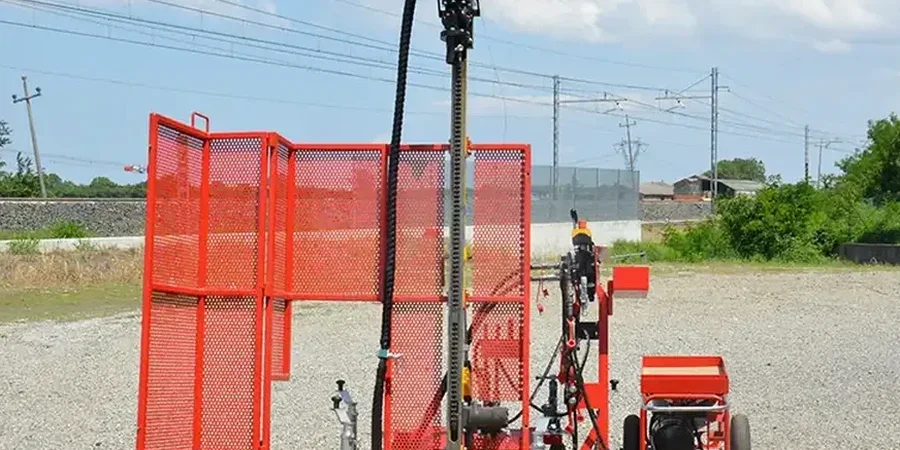
Technical reference image — Rochester

Local ground factors

A practical observation: in the wedge of land between the Erie Canal and Lake Ontario, the upper 10 feet of soil often reads as stiff clay during an August drilling campaign. That same clay turns to near-liquid mush in March when the frost line recedes and the water table peaks at 18 inches below grade. An SPT log from a dry summer borehole will overestimate winter bearing capacity unless you account for seasonal saturation. We schedule follow-up borings during high-water periods for critical structures, or we run in-situ permeability tests in the same borehole to model how quickly the formation drains. Overlooking that seasonal swing has led to footing settlements in several North Greece subdivisions, and the repair invoices ran well into six figures.

Need a geotechnical assessment?

Reply within 24h.

Email: info@geotechnicalengineering1.sbs

Technical data

ParameterTypical value
StandardASTM D1586-11
Hammer typeAutomatic trip, 140 lb, 30-inch drop
Sampling intervalEvery 5 ft or at stratum change
Energy calibrationPer ASTM D4633
Borehole diameter6.0 to 8.0 inches (hollow-stem auger)
Reporting metricN-value (raw) and N60 (corrected)
Log formatgINT or LogPlot digital, PDF and CSV export

Associated technical services

01

SPT Drilling & Sampling

Hollow-stem auger advancement with split-spoon sampling at prescribed intervals. Each drive records blow counts for three consecutive 6-inch increments. Disturbed samples are bagged, logged, and available for index testing.

02

N-Value Correction & Reporting

Raw N-values corrected to N60 for hammer energy, rod length, borehole diameter, and sampler condition. Results presented in standardized boring logs with USCS classifications derived from visual-manual inspection.

03

Complementary Testing Suite

We coordinate Atterberg limits and grain-size analysis on split-spoon samples from the same borehole, so your geotechnical report moves from N-value to shear-strength parameters without a second mobilization.

Reference standards

ASTM D1586: Standard Test Method for Standard Penetration Test (SPT) and Split-Barrel Sampling of Soils, ASTM D2487: Standard Practice for Classification of Soils for Engineering Purposes (Unified Soil Classification System), ASTM D4633: Standard Test Method for Energy Measurement for Dynamic Penetrometers, IBC Chapter 18: Soils and Foundations (2021 New York State adoption), ASCE 7-22: Minimum Design Loads for Buildings and Other Structures

Questions and answers

What does an SPT boring program cost for a typical Rochester commercial lot?

For a two-borehole program to 30 feet depth with standard sampling, the range runs US$540 to US$680 per borehole, including mobilization within Monroe County, hollow-stem auger drilling, split-spoon sampling, and a PDF boring log with corrected N60 values. Sites requiring traffic control on Monroe Avenue or extra depth due to deep fill will shift the upper end of that bracket.

How deep do you typically have to drill in Rochester to reach competent bearing?

It depends entirely on the landform. In the downtown core along Main Street, competent glacial till or bedrock often appears between 15 and 30 feet. Out in the Chili-Ogden area, where glaciolacustrine silts dominate, we have logged 60 feet of soft material before hitting anything drillable. We always recommend at least one boring that penetrates 10 feet into refusal material to confirm you are not sitting on a boulder.

How do you handle SPT refusal on boulders in the drumlin fields?

When we encounter refusal at an unexpected depth, we log the blow counts that led to it, offset the borehole by 5 feet, and redrill. If refusal repeats at the same approximate elevation, we classify it as probable bedrock and switch to a core barrel. If the second hole passes through, we flag a boulder and continue sampling. The distinction matters for pile design.

Do you provide N60 corrections or just raw N-values?

Both. Every log we issue includes the raw N-value and the corrected N60, with a footnote describing the hammer energy ratio used for correction. We calibrate our hammers to ASTM D4633 annually and can provide the calibration certificate upon request. For liquefaction studies, we also report (N1)60 normalized to 1 atm overburden.

Can you perform SPT borings in limited-access sites, like between two existing buildings?

Yes. We run a compact CME-45 track rig that fits through a 36-inch gate and can operate with 12 feet of overhead clearance. For interior drilling, we switch to a portable tripod setup with a safety hammer, though the energy calibration differs and we note that on the log.
Location and service area

We serve projects in Rochester and surrounding areas.

View larger map