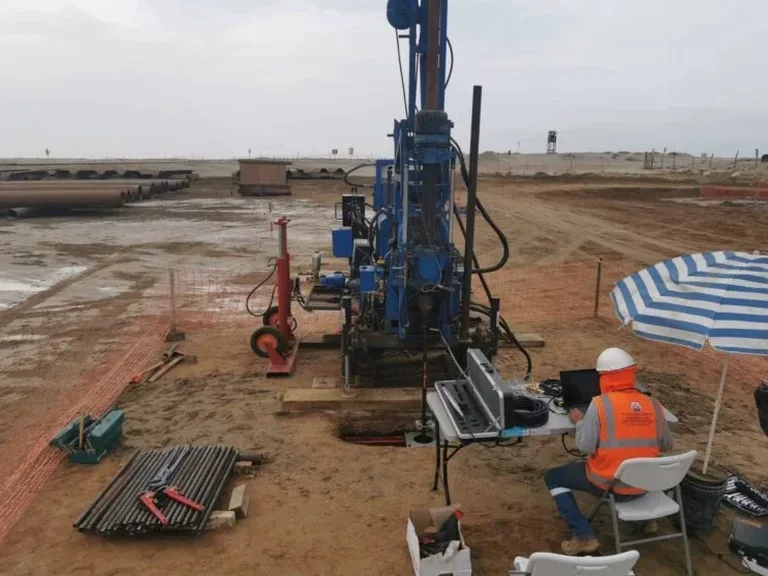
Rochester sits on a complex glacial legacy where the advance and retreat of the Laurentide Ice Sheet left behind a drumlin field, deep tills, and lacustrine clays that shift dramatically within a few hundred feet. The northern stretches near the Irondequoit Bay outlet often hide soft, compressible silts under a stiff crust, and standard drilling alone can miss these critical transitions. Our laboratory team runs the CPT test with a 20-ton hydraulic rig that pushes a calibrated cone into the subsurface at a constant 2 cm/s, giving you a continuous, real-time read of tip resistance, sleeve friction, and dynamic pore pressure. When we need to verify refusal depth in dense lodgment till, we pair the electronic log with SPT drilling to calibrate sampler blow counts against the cone data, a combination that has saved more than one foundation design on the city's south side.
Continuous CPT data eliminates the guesswork between SPT sample intervals, catching thin compressible seams that can cause differential settlement.
Local ground factors
Rochester's historic urban core expanded rapidly along the Genesee River terraces and the old Erie Canal alignment, where early industrial fill, buried foundations, and undocumented backfill are still encountered beneath modern asphalt. The city's brownfield redevelopment push has put a premium on knowing exactly what's underground before the first shovel breaks ground. A misplaced footing on a lens of loose hydraulic fill can settle unevenly within the first freeze-thaw cycle, and the cost to underpin a compromised foundation dwarfs any upfront testing budget. The CPT gives us a near-continuous sleeve friction signature that flags these man-made anomalies immediately; when the friction ratio spikes erratically in the top 15 feet, we know we're in old debris and not native glacial till. Ignoring that signature means designing on material that has no predictable engineering behavior, a gamble no structural engineer should take.
Questions and answers
What is the typical cost of a CPT sounding in Rochester?
For a standard CPT sounding to depths of 40 to 60 feet in Rochester tills, the cost generally falls between US$180 and US$240 per push, depending on mobilization distance within Monroe County and the number of dissipation tests requested. Deeper pushes over 60 feet or sites with difficult access may shift the pricing slightly.
How long does a CPT test take on site?
A single CPT sounding to 50 feet, including setup, pushing, and a couple of dissipation tests, typically takes between 45 and 90 minutes. The continuous push rate of 2 cm/s means the actual penetration is quick; most of the time goes into rig anchoring and pore pressure equalization pauses.
Can CPT replace soil borings for my Rochester project?
The CPT provides a continuous profile of soil behavior type and engineering parameters, but it does not recover a physical sample. For projects where we need to see the actual soil fabric or run laboratory classification tests, we recommend pairing the CPT with at least one SPT drilling location to collect disturbed and undisturbed samples for grain size and Atterberg limits verification.
What happens if the cone hits refusal on a boulder in the till?
The dense lodgment till and occasional glacial erratics around Rochester can stop the cone, usually when the tip resistance exceeds 400 to 500 kg/cm². At that point we record the refusal depth, and if the project requires deeper information, we can switch to a solid-stem auger boring at the same location to advance through the obstruction.